Article Contents
So I found myself with some rare free time during the recent Coronavirus lockdown,
so what have I been doing?
My WordPress journey
My first few WordPress sites were built using existing themes, with a bit of customisation. But it quickly became apparent that every theme author did things differently, so with each new theme I used I had to start again with learning how to set it up. It also meant that when a client contacted me with a question about their website I had to think about which theme was in use before I could answer.
Starter Theme
So I decided to write my own theme, a starter theme, that would be the starting point I would use for all my clients websites. This would mean I only needed to know how to set up one theme and would make answering queries from clients faster.
Parent and Child Theme
I used the starter theme method for around five years before making the decision to start using the parent and child theme arrangement. The parent theme would handle all the bits that I included on all sites, with the child theme handling the look of the website and any custom bits specific to the website.
After exploring a few parent themes and theme frameworks, including Genesis, I decided I would use my own starter theme as the basis of a parent theme, updating and improving it with each site completed. This has been great, I know every line of code and it and it has made getting sites launched so much faster.
This served me well for four years, but with the recent advances and changes in WordPress meant I was spending more and more time improving the parent theme.
I just didn’t have enough time to work on creating new sites for clients and work on all the bits needed for a good parent theme.
Time to think
During the March lockdown my workload tailed off, so I found myself with enough time to stop, think, and decide the best way to continue designing WordPress sites for clients.
So I started downloading and experimenting with theme frameworks again. But after working with WordPress for nearly ten years this time around I knew a lot more about what I did and didn’t want a theme framework to do.
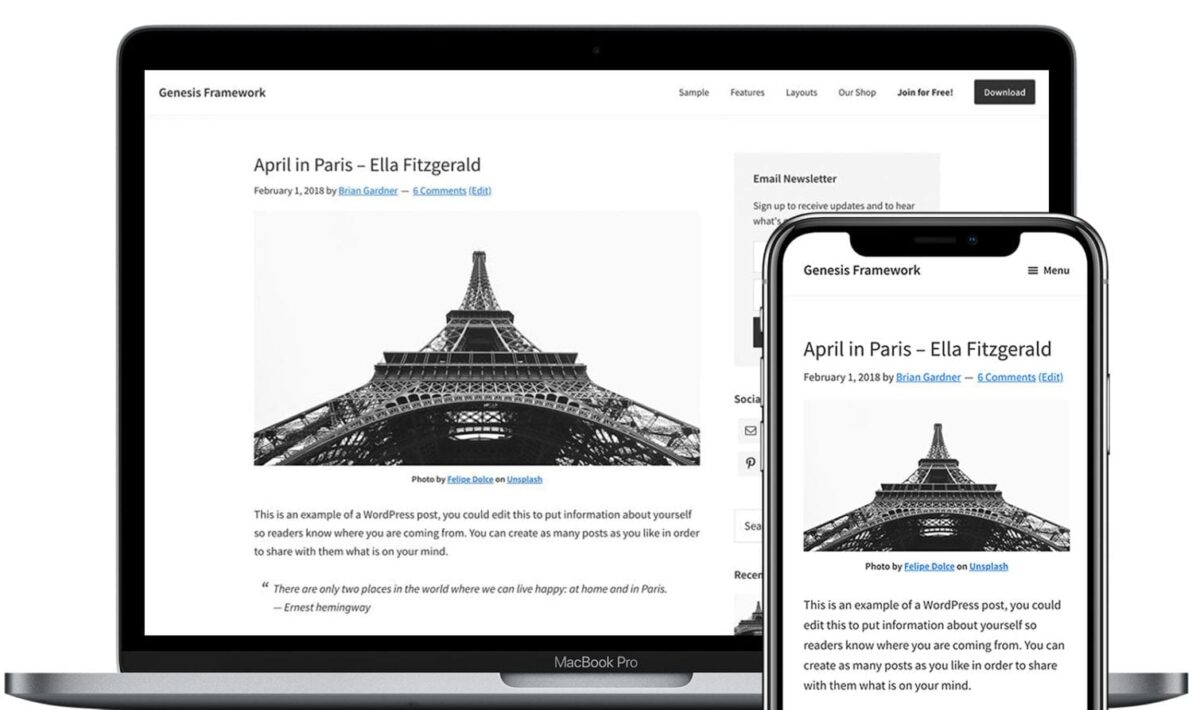
The Genesis Framework
When I looked at Genesis a few years ago I was a bit put off by its complexity, and at the time I didn’t have the time to learn about it. But when I explored Genesis this time it suited me perfectly. My own parent theme uses lots of hooks and filters and Genesis is pretty similar. So I get to design and build websites using child themes in the same way I’m used to – but now I don’t have to worry about looking after the framework, the team at StudioPress do that bit.
For my clients it also means that their websites are built on an industry standard framework, so should they decide to use a different developer or I leave the sector they won’t have a problem finding someone who can pick up where I left off.
The Gutenberg Editor
One of the biggest changes to WordPress in recent years was the introduction of the new editor called Gutenberg. This aims to make creating content a lot more visual. I’ve been wary of using this on any client websites as the pace of changes has been incredibly fast and I didn’t want to write anything that was then redundant in a few weeks’ time. But as lockdown continued, and my workload remained light, I began experimenting with the Gutenberg editor and started enjoying the process.
I had purposely avoided introducing clients to page builders, I’ll be honest, not all of my clients have the time or skill to produce something that looks nice. One of the great things about Gutenberg is how I can restrict things, e.g. keeping the colour palette on brand, or the ability to produce layout patterns that are easily used by clients.
I’ve now completed over ten sites using the Genesis framework and Gutenberg editor for a mix of new and existing clients and I’m now looking forward to seeing where WordPress goes in the next ten years.